Many white male leaders aren’t opposed to inclusion work—they’re uncertain about how to participate in it.
They may believe in fairness, support diverse teams, and want people to feel respected at work. They may also feel the pressure of a charged cultural environment where DEI conversations can quickly become politicized, misunderstood, or professionally risky. As a result, many leaders choose caution. They stay quiet, delegate the work to others, or wait for someone else to define the next step.
That caution creates a leadership gap. In most organizations, white male leaders still hold significant influence over hiring, promotion, compensation, culture, meeting dynamics, informal networks, and strategic priorities. When leaders don’t understand their role in inclusion work, their silence affects the system around them.
The answer isn’t to shame these leaders into participation or to position them as the heroes of the conversation. The answer is to give them a clear, practical role grounded in listening, responsibility, humility, and action. Inclusion work becomes stronger when leaders with influence understand how to use that influence constructively and proactively.
Support Is Not the Same as Leadership
Many leaders describe themselves as supportive of inclusion. They attend the training, approve the budget for the employee resource group event, agree with the values statement, or express private encouragement to a colleague doing the work. Those actions can matter, but they don’t automatically add up to inclusive leadership.
Support often stays at the level of agreement. Leadership shows up in decisions, behaviors, and follow-through. A leader moves from support to responsibility when they start asking who has access to opportunity, whose ideas are being overlooked, who is doing unpaid emotional labor, and where the organization’s stated values aren’t reflected in everyday practices.
This distinction matters because many white male leaders mistake nonresistance for contribution. They assume that because they aren’t standing in the way, they’re helping. In reality, cultures are shaped less by what leaders privately believe and more by what they repeatedly notice, reward, challenge, and protect.
A leader who supports inclusion may say “I believe this matters.” A leader who is actively engaged examines how team norms, business decisions, and power dynamics either reinforce or weaken that belief. That shift is the difference between being adjacent to the work and being accountable for part of it.
Throughout my career, I’ve worked with leaders who genuinely care about inclusion but don’t always recognize the gap between what they believe and how they lead. I’ve learned that support is about intention, and leadership is about action. Inclusive leadership begins when we stop asking only “Do I believe in this?” and start asking “How does what I believe actually show up in how I lead?”
The Role Has to Be Clear Because the Stakes Are Practical
One reason white male leaders hesitate is that the available roles often feel poorly defined. They may hear that they should speak up but not speak over others. They may be told to listen but also to take action. They may be asked to use their privilege and influence while also being warned not to center themselves. All those expectations can be valid, but without a practical path, leaders often default to inaction.
Role clarity helps leaders participate without turning the work into a performance. It gives them a way to understand when to listen, when to ask better questions, when to name a pattern, and when to use their authority to remove barriers. It also helps them recognize that inclusion work isn’t a separate identity project. It’s part of how they lead people, shape culture, and make business decisions.
For example, a senior leader doesn’t need to dominate an employee resource group conversation to prove commitment. They can attend with humility, listen for recurring barriers, ask what support would be useful, and then follow through where their authority gives them leverage. They can also advocate for the group’s concerns in executive rooms where those employees may not be present.
That kind of role is practical, not performative. It doesn’t ask leaders to have perfect language or complete expertise. It asks them to become more aware of their privilege and influence and more deliberate about how they use it.
Inclusion Cannot Be Delegated to the People Most Affected by Exclusion
Organizations often place the heaviest burden for inclusion on HR teams, DEI professionals, women, people of color, and employee resource groups. These groups frequently carry the responsibility of educating others, naming problems, proposing solutions, and sustaining momentum. Their work is essential, but they can’t be expected to carry the full weight of organizational change while senior leaders observe from the sidelines.
This is where white male leadership matters in a specific way. In many corporate environments, white male leaders have access to rooms, relationships, and decision-making channels that others may not. They can raise issues without facing the same level of scrutiny. They can question patterns that others have been penalized for naming. They can make inclusion part of performance, succession, and strategy conversations rather than leaving it as an optional cultural topic.
Using influence well doesn’t mean speaking for marginalized colleagues. It means paying attention to what they’ve already been saying, amplifying it, and helping move the organization toward action. It means sharing responsibility for an inclusive culture instead of outsourcing the risk to those who have the most at stake.
I’ve been in many leadership meetings where an issue involving inclusion surfaces and, almost instinctively, everyone looks to the HR representative, the women, or the person of color in the room for the answer. I know that feeling because I’ve been the person they looked toward.
What I learned is that HR or the DEI leader can provide expertise, challenge thinking, and help create the conditions for change, but we can’t own inclusion for the business. The most meaningful progress happens when leaders stop asking “What is HR going to do about this?” and start asking “What am I going to do differently?”
The Ally to All-In Framework Gives Leaders a Path Forward
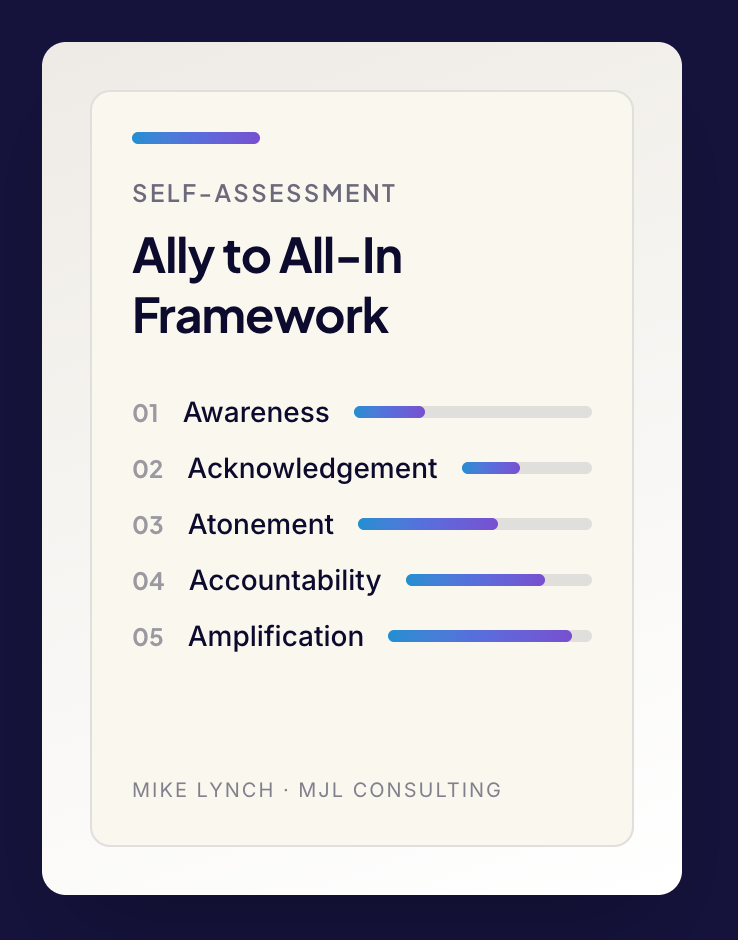
Many leaders need a structure that helps them move from uncertainty to accountable participation. That’s where the Ally to All-In Framework becomes useful. It gives leaders a way to understand that allyship is a starting point, not a destination.
The framework begins with awareness, where leaders learn to see patterns they may have overlooked. Acknowledgment asks them to recognize their own identity, privilege, influence, and role in the system. Atonement requires more than recognizing a mistake—it asks leaders to repair trust and take responsibility when harm has occurred. Accountability brings the work into ongoing decisions and behaviors. Amplification focuses on using privilege and influence to elevate voices, contributions, and concerns that have too often been ignored.
The value of the framework is that it makes growth more concrete. A leader may realize they have awareness but haven’t yet acknowledged their role publicly or relationally. Another leader may want to amplify others but hasn’t built enough trust through listening and accountability. The framework helps leaders see where they are, what’s missing, and what kind of action the moment requires.
This is especially important in organizations where inclusion conversations have become fatigued or politically sensitive. Leaders need more than a statement of values. They need a method for staying engaged when the conversation is uncomfortable, imperfect, or unresolved.
The Business Cost of Passive Allyship
When influential leaders remain passive, the cost shows up in culture before it appears in metrics or the bottom line. Employees notice who speaks up and who stays quiet. They notice whose concerns get acted on and whose concerns get managed down. They notice whether inclusion is treated as a leadership expectation or as a side conversation that can be postponed when business pressure increases.
Over time, that ambiguity weakens trust. Talented employees become less willing to share ideas, raise concerns, or invest deeply in an organization where they don’t see leaders taking responsibility for the culture they claim to want. HR and DEI teams become exhausted trying to drive change without enough executive partnership. Senior leaders then wonder why engagement, retention, and credibility are harder to rebuild.
This is why inclusion must be understood as a business and culture responsibility. It affects how people collaborate, how teams make decisions, how conflict is handled, and whether employees believe leadership can be trusted with difficult truths. For white male leaders, engaging in this work isn’t about taking on an unrelated social cause—it’s about leading more honestly inside the organization they already influence.
I’ve watched the dynamic in a room, and an organization, change when a leader is willing to say “I may not fully understand this, but I want to.” That simple act of vulnerability can give others permission to speak more honestly, ask harder questions, and share perspectives more freely. I’ve learned that leaders don’t need to have all the answers. But they do need to be willing to stay in the conversation, especially when it gets uncomfortable.
Moving From Hesitation to Responsible Engagement
White male leaders don’t need to enter inclusion work with all the answers. In fact, believing they need all the answers is often part of what keeps them out of the conversation. The clearer and more useful expectation is that they enter with self-awareness, curiosity, courage, and a willingness to be accountable for their impact.
A clear role gives leaders a way to move forward without making the work about themselves. They can listen without disappearing. They can speak without taking over. They can use their privilege and influence without assuming they’re the center of the story. They can make mistakes, repair, and keep going.
That’s the movement from ally to all in. It’s the shift from private agreement to visible responsibility, from symbolic support to leadership practice, and from uncertainty to sustained participation. In a moment when many organizations are retreating from difficult conversations, leaders who know their role can help keep the work grounded, practical, and connected to trust.
The current fatigue and backlash around DEI can make it tempting for leaders to step back, stay quiet, or wait for current conversations to pass. But this is exactly when leadership matters most. Moving from ally to all in isn’t about having the perfect words or taking on every issue. It’s about being clear about the role you can play, using the influence you already have, and continuing to lead in a way that turns your values into action.