Many leaders support inclusion in principle. They believe people should be treated fairly, they want strong teams, and they value a workplace where employees feel respected.
That support matters, but it does not automatically change how an organization operates.
Inclusion becomes a leadership issue when those beliefs shape decisions, habits, expectations, and follow-through. For white male leaders and other high-influence leaders, this distinction matters because their role is not simply to approve the work from a distance. Their role is to help make inclusion part of how leadership is practiced every day.
That is where many well-intentioned leaders get stuck. They see themselves as allies, but their support remains occasional, informal, or disconnected from the systems they help shape. Moving from ally to all-in requires a more active understanding of what inclusive leadership actually asks of them.
Support Often Lives in Agreement
Supporting inclusion often begins with agreement. A leader agrees that diversity matters. He agrees that employees should feel included. He agrees that bias, exclusion, and inequity create real harm. He may attend an event, approve a training, participate in a listening session, or express appreciation for the people doing the work.
These actions have value, but they do not necessarily change leadership practice.
Agreement can remain safely internal. A leader can believe the right things while still avoiding the places where his authority has practical weight. He can support an employee resource group without addressing the barriers the group raises. He can say inclusion matters while overlooking who gets promoted, sponsored, challenged, or given room to grow.
This is why supportive intent alone is limited. In organizations, employees pay attention to patterns. They notice where decisions get made, what gets resourced, what gets delayed, and what receives executive attention.
Support becomes limited when it does not move into decisions.
Inclusive Leadership Shows Up in Daily Choices
Leading inclusively is more active and more demanding than supporting the idea of inclusion. It requires leaders to examine how their everyday choices shape the employee experience.
This can be as simple as how a meeting is run. Who gets invited? Who speaks first? Whose ideas are passed over? Who receives credit? A supportive leader may believe everyone should have a voice. An inclusive leader looks closely at whether the room actually functions that way.
The same applies to talent decisions. Inclusive leadership asks leaders to look at who receives stretch assignments, who has access to informal mentoring, who is considered ready for advancement, and how potential is defined. These questions are not separate from the business. They directly affect performance, retention, trust, and the strength of the leadership pipeline.
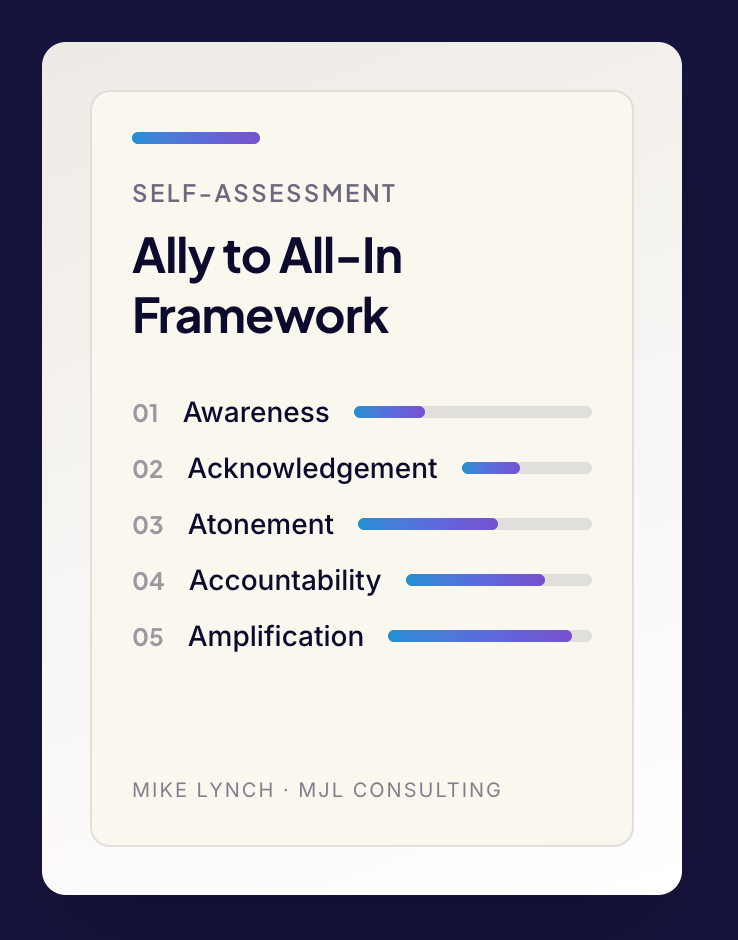
This is where the Ally to All-In Framework becomes practical. Awareness helps leaders see patterns they previously missed. Acknowledgment asks them to recognize their own role within those patterns. Accountability requires them to adjust behavior and decisions over time.
Inclusive leadership is built through repeated choices. It is the steady practice of aligning leadership behavior with the culture a leader says he wants to build.
Influence Has to Be Applied
White male leaders often hold significant influence inside organizations, even when they do not think of themselves as influential. They may have access to senior rooms, trusted relationships with decision-makers, and credibility within informal networks. Those forms of access can affect what becomes a priority.
Supporting inclusion may mean believing underrepresented employees should have more opportunity. Leading inclusively means examining whether opportunity is actually being distributed fairly.
That might involve asking why a leadership slate lacks diversity, questioning whether promotion criteria are too narrow, or making sure feedback from employee resource groups reaches the people who can act on it. It may also mean sponsoring someone whose contributions have been overlooked, inviting different perspectives into a decision, or challenging a pattern that others have been naming for years.
Using privilege and influence does not mean speaking over people or positioning oneself as the hero of the work. It means taking responsibility for the access a leader already has. It means asking, “Where can my role help remove friction, open a door, or make this concern harder to ignore?”
That kind of influence is practical. It changes the conditions around the conversation.
Inclusive Leaders Stay with the Work
One of the clearest differences between supporting inclusion and leading inclusively is follow-through.
Support often shows up in moments: a public statement, a heritage month post, a panel discussion, a training, or a conversation after an employee concern is raised. Inclusive leadership continues after the visible moment ends. It asks what will change, who will own it, how progress will be reviewed, and whether employees experience a real difference.
This matters because employees have seen plenty of symbolic support. They have heard leaders say the right things and then watched the organization return to old patterns. Over time, that gap damages trust.
Inclusive leaders understand that trust is built through consistency. They do not need to solve everything immediately, and they do not need perfect answers. They do need to stay engaged long enough to learn, act, repair, and keep going.
That is why allyship cannot be treated as the destination. Allyship may describe a leader’s intention, but going all-in describes a deeper commitment to sustained leadership practice.
The Takeaway
Supporting inclusion is a meaningful starting point, but leaders with influence are called to do more than agree with the idea. They are responsible for how inclusion shows up in the systems, conversations, and decisions they help shape.
For white male leaders, this does not require perfection. It requires clarity. It requires the humility to listen, the courage to participate, and the discipline to use influence in ways that build trust and expand opportunity.
The movement from ally to all-in begins when support becomes part of how a leader actually leads. Employees do not only need to know where their leaders stand. They need to experience that commitment in meetings, decisions, development opportunities, accountability, and follow-through.
Take the next step
What would change if inclusion shaped the way you lead every day? In my book, From Ally to All-In, I explore five stages for turning supportive intentions into a sustained commitment to inclusive leadership. Read From Ally to All-In.