Many leaders who care about inclusion still stay quiet when DEI conversations become uncomfortable. This is especially true for white male leaders in positions of influence. They often believe in fairness, want healthy workplace cultures, and genuinely do not want to cause harm. Yet when the moment comes to speak, ask a question, challenge a pattern, or enter a difficult conversation, they hesitate.
That is the leadership gap I saw throughout my corporate HR career and now address in my consulting work: Many leaders are not resistant to inclusion, but they are unsure how to participate responsibly.
That silence is usually not caused by indifference. More often, it comes from fear, uncertainty, fatigue, or a lack of clarity about what responsible engagement actually looks like. The problem is that good intentions do not offset the impact of absence. When leaders with influence stay quiet, others are left to carry the conversation, the risk, and the emotional labor.
Understanding why that silence happens is an important step toward moving beyond passive allyship and into more active, accountable leadership.
Silence Often Begins as Self-Protection
Many leaders stay silent because they are trying to avoid making a mistake. They worry about using the wrong words, being misunderstood, offending someone, or creating a professional problem they do not know how to repair.
That fear is real. DEI conversations can feel high stakes, especially in workplaces where cultural tension, political backlash, and legal uncertainty have made leaders more cautious. For white male leaders, there can also be a sense that they are entering a conversation where they are expected to already understand the rules, even if they privately feel unprepared.
So they wait. They listen from a distance. They tell themselves they are being respectful by not taking up too much space. They assume that if they do not interfere, they are doing less harm.
The difficulty is that self-protection can easily disguise itself as wisdom. A leader may believe he is “staying in his lane,” when in reality, he is avoiding the discomfort that comes with being visible in the conversation. He may think silence communicates respect, while employees experience it as distance, hesitation, or lack of commitment.
This is one of the reasons role clarity matters so much. Leaders do not need to enter DEI conversations as experts. They do need to enter with humility, curiosity, and a willingness to be accountable for their impact.
Some Leaders Confuse Listening with Disappearing
Listening is essential to inclusive leadership. Leaders need to hear the lived experiences of others without defensiveness, interruption, or the urge to quickly solve the problem. But listening is not the same as disappearing.
This distinction is where many leaders struggle. They know they should not dominate the conversation. They understand that centering themselves can create more harm. But without a clear model for participation, they often move too far in the opposite direction and become passive observers.
Responsible listening should lead to better action. A leader can listen to an employee resource group and then ask what barriers need executive attention. He can hear concerns about advancement and then examine promotion patterns. He can notice that certain employees are carrying the burden of educating the organization and then use his influence to bring more leaders into the work.
A common example shows up in leadership meetings after employees have raised concerns about belonging, advancement, or bias. A leader may hear the feedback, nod along, and privately agree that the concerns are valid. But if that leader never brings the issue into talent reviews, succession planning, performance discussions, or executive decision-making, his listening has not yet become leadership.
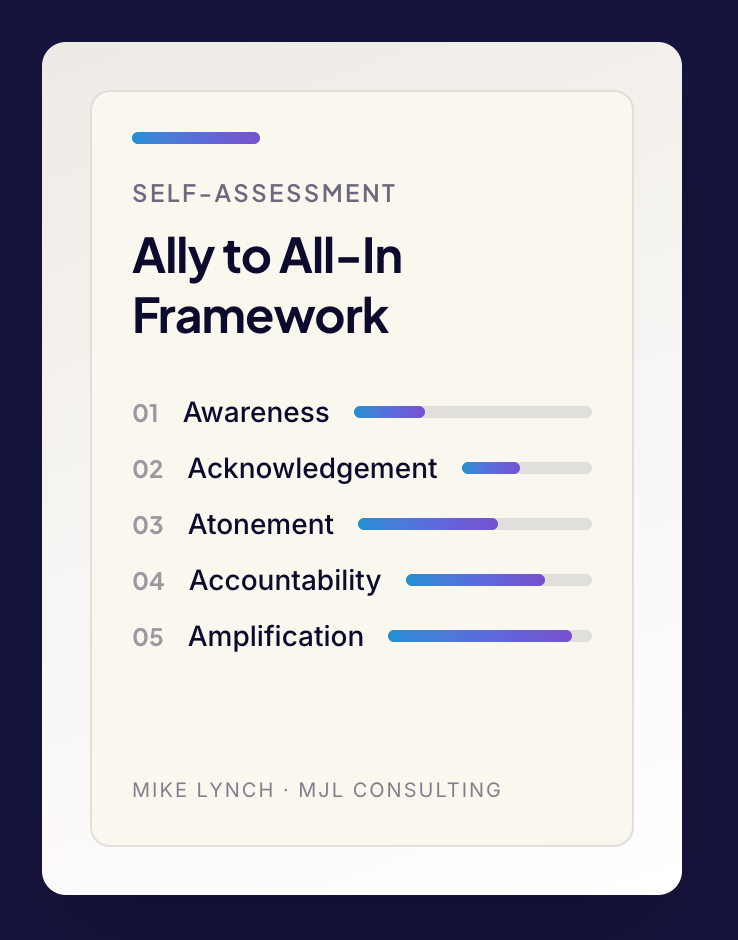
The Ally to All-In Framework helps make this movement clearer. Awareness asks leaders to see what they have previously overlooked. Acknowledgment asks them to recognize their own role and influence. Those early stages require listening, but they are not meant to become a place where leaders stop. They prepare leaders to take more thoughtful, accountable action.
Silence becomes a problem when listening never turns into responsibility.
The Burden Shifts When Leaders Stay Quiet
When leaders opt out of DEI conversations, the work does not disappear. It shifts onto someone else. Often, that “someone else” is HR, a DEI practitioner, a woman leader, a leader of color, or an employee resource group. These individuals are asked to name the problem, educate the organization, absorb resistance, recommend solutions, and keep the conversation moving. Meanwhile, the leaders with the greatest structural influence may remain supportive but uninvolved.
That pattern creates exhaustion. It also reinforces the belief that inclusion is separate from core leadership. Employees begin to see DEI as a specialized function rather than a shared responsibility for how the organization operates.
White male leaders, in particular, need to understand the practical significance of their participation. In many organizations, they still have access to decision-making rooms, informal networks, and credibility channels that others do not. Their voices can help move a concern from feedback to a leadership priority. Their questions can change what gets measured. Their follow-through can signal that inclusion is connected to culture, performance, and trust.
Using privilege and influence well does not mean taking over the work. It means refusing to let others carry it alone.
The First Step Is Not Perfection
One reason leaders remain silent is that they assume engagement requires perfect language, complete understanding, or total confidence. That assumption keeps many good leaders stuck.
A more useful starting point is honest participation. A leader can say, “I want to understand this better.” He can ask, “What am I missing?” He can acknowledge, “I realize I have not been as active in this conversation as I should be.” He can follow that acknowledgment with action: reviewing patterns, sponsoring talent, showing up consistently, and holding himself accountable for what changes.
This kind of engagement is not dramatic. It is steady. It is built through repeated choices that show employees the leader is paying attention and willing to learn.
Going all-in does not mean having every answer. It means accepting that leadership includes discomfort, especially when the conversation touches power, identity, trust, and opportunity. The leaders who grow are not the ones who avoid mistakes entirely. They are the ones who stay engaged long enough to learn, repair, and act with more integrity over time.
The Takeaway
Well-intentioned silence is still silence.
For leaders with influence, especially white male leaders, the goal is not to speak constantly or control the conversation. The goal is to participate with humility and responsibility. That means listening carefully, acknowledging the role you play, using your influence where it matters, and staying present when the work becomes uncomfortable.
Allyship only becomes meaningful when it changes visible leadership behavior. If support never affects what a leader notices, names, measures, challenges, sponsors, or follows through on, it remains private agreement rather than active responsibility.
That is the movement from ally to all-in: a sustained commitment to engage, learn, repair, and use leadership influence in ways that help build a more inclusive culture.
Take the Next Step
Ready to take a more active role in the conversations that matter? In my book, From Ally to All-In, I share a five-stage framework to help leaders move beyond good intentions and use their influence more responsibly. Read From Ally to All-In.